INTERVIEW with Antoaneta Tica || 2026 Finalist for The Australian Wearable Art Festival
SD: How and when did you get into the Wearable art?
AT: I studied fashion at UNArte Bucharest. As an art university, the teachers' approach regarding fashion was then, as now, more artistic, than technical. I was already a connoisseur of technique, also a consumer of art and performances, especially dance, but at university I discovered that a garment can be an art object worn and brought to life by the human body. During that period I created my first works, not as complex as the current ones, but they are particularly important for my artistic evolution. In fact, I keep almost all of them with great care, even if some of them have deteriorated. Sometimes I even put them on display in exhibitions. Then I discovered wearable art events, most of them in Australia and New Zealand, and I became addicted.
SD: What advice would you get to a younger version of yourself when you when starting out in wearable art?
AT: I have always loved art, but I had a pretty long period where I didn't practice it in any form. I think I would tell my younger self to get into this field sooner because it is absolutely wonderful. It is a very difficult field, especially because the work process is extremely laborious, with each piece taking months of work. However, since I started working in this field, I feel fulfilled as an artist. Every time I complete a piece, I feel a sense of happiness that cannot be compared to anything else.Wearable Art encompasses everything I love: the costume, the technique, the dance, mixed with a lot of creativity and freedom. And the connection with the body is fantastic! The motion turns it into a work of art that has its own life, as if it had a heart. It is wonderful for an artist to see this happen with his work, but it is also wonderful for the viewers.
SD: What keeps you inspired?
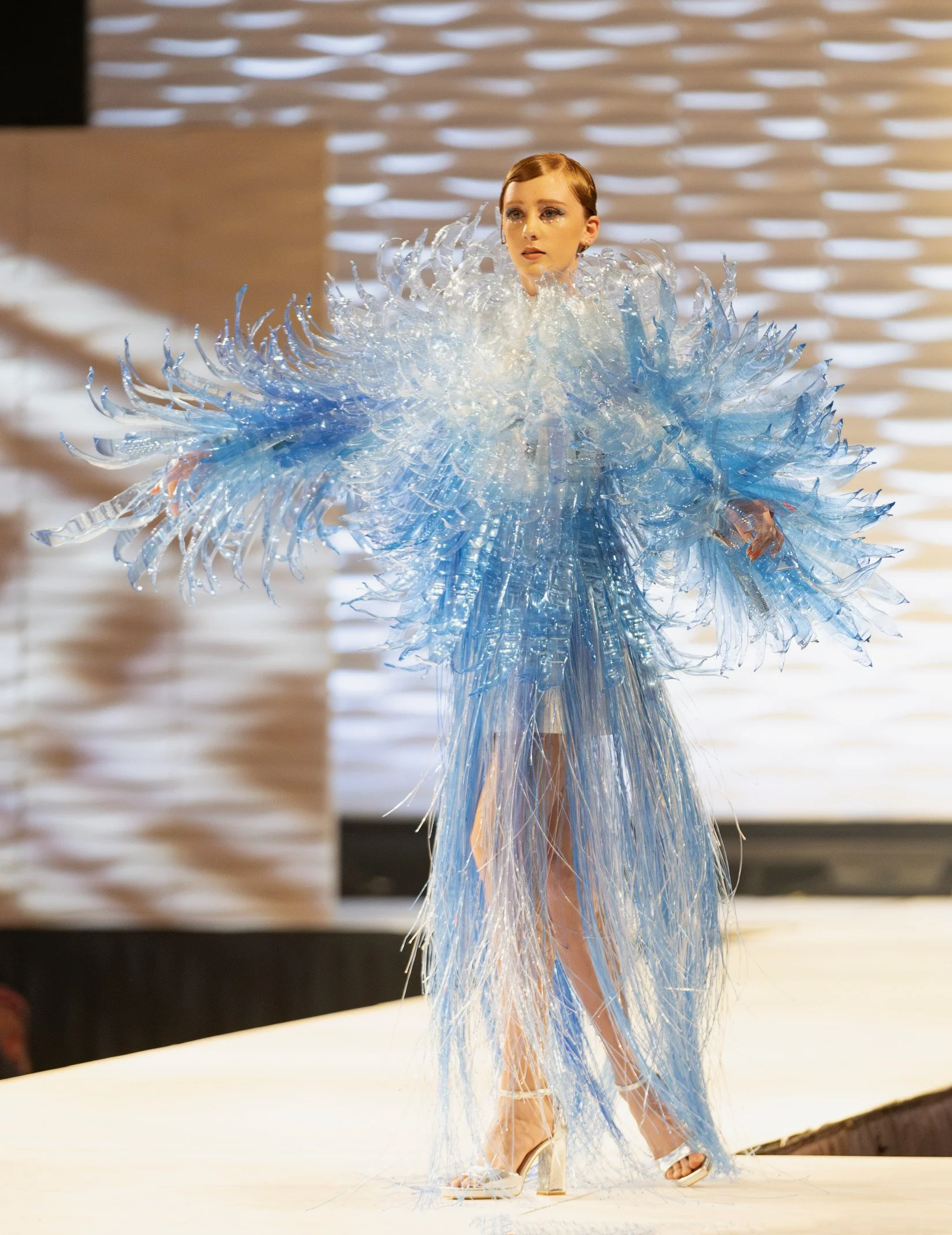
AT: My main inspiration is the material, whether it is plastic, paper, wire, textile or who knows what?. I am willing to experiment with any material and any technique to transform it into an expressive texture. I deconstruct it, cut it, shred it, melt it, roll it, weave it, knit it, but most of all, I reconstruct it completely differently than it was, in a way that, often, the original material is difficult to be recognised. As an example, for several years I have been creating a three-dimensional texture from rolled plastic that at first glance seems to be done from pens, and people are very amazed when they look closely and notice that in fact the material is completely different that they thought. This delights me and makes me happy that I can create unexpected things, which surprise the viewer. There is also a negative area that feeds my inspiration, which are various issues that make me think and that I want to bring to the attention of the viewer in order to make them think. For almost ten years I have been bringing environmental issues to the forefront, creating wearable art from polluting materials, which I transform from something ugly and useless, into something beautiful. I think it is important to perceive this dual characteristic of any material or object. I emphasized this opinion with my work from 2025, Duality, which addresses the dualism of plastic, and which I divided into two halves, right and left, one chromatically warm, the other cold, one good, the other bad, one with positive effects, the other with negative effects. In fact, it depends on us how we use them.
SD: Explain your understanding of sustainable fashion practices and how you incorporate them into your design process.
AT: For me, sustainable fashion means using natural materials, quality products that last as long as possible, and when they are no longer worn, recycling them, and throwing as few as possible into landfills. However, in wearable art works I rarely use textiles, just when a base is needed to support the other materials with which I build the work. For this base I use cotton canvas, not only for its strength and as a support for the applied texture, but also because it allows the body to breathe. For me to wear synthetic materials is not an option and often, my pieces are made of plastic, which is a real a problem for the wearer. In addition, the costumes are heavy, can block certain movements or can be uncomfortable, especially if worn for a long time. All this means more effort and are energy consumed by the performer. In order to achieve the best possible result from all points of view, both creative and conceptual, as well as technical, I always try on my works, I want to feel them and perceive them from the inside. It is a way to connect with the idea, with the material, but also with the performer. Along with materials, concepts can also be related to sustainable fashion. I can't give many details, but I'm currently working on a work that deals with the pollution caused by fast fashion. In fact, all my works have concepts that refer to environmental problems, whether it's water pollution with microplastics, the greenhouse effect or the danger of bee extermination. Of course, fashion is one of the world's biggest polluters, but there are many others. We need to take them all into account and try to mitigate their negative effects.
SD: You’re a 2026 finalist in The Australian Wearable Art. What excites you most about this?
AT: Yes, this is my third time attending these events. I have known AWAF for a long time, but I first attended in 2024 with Sprinkle, in plastic bottles, then of course in 2025, with Duality, in plastic from packaging. It’s not only that I had the honour of being awarded for these two works, but also that I was received very well. Helen Perry and Wendy Roe, the co-founders, are both really fantastic! Than I can’t wait to see the work worn by Lilah, my model who I have been collaborating with since 2024. She is both beautiful and a great performer and, although she is very young, she manages to bring my works to life with great mastery. More, I hope to be able to attend in person, to see again the wonderful people who are involved in the events and to meet new people. It is an absolutely fantastic community and this is one of the reasons that makes me keep going. As a conclusion, of course I am very excited to be returning to AWAF 2026! Fingers crossed for me to come!
Tickets are going fast. Go and buy tickets to see Antoaneta Tica in The Australian Wearable Art Festival here
The Australian Wearable Art Festival Website: https://australianwearableart.com.au/
The Australian Wearable Art Festival Instagram: https://www.instagram.com/australianwearableart/
The Australian Wearable Art Festival Facebook: https://www.facebook.com/australianwearableart/
Antoaneta Tica:
Behance: https://www.behance.net/AntoanetaTica
Facebook: https://www.facebook.com/AntoanetaTica/
Instagram: https://www.instagram.com/antoanetatica/
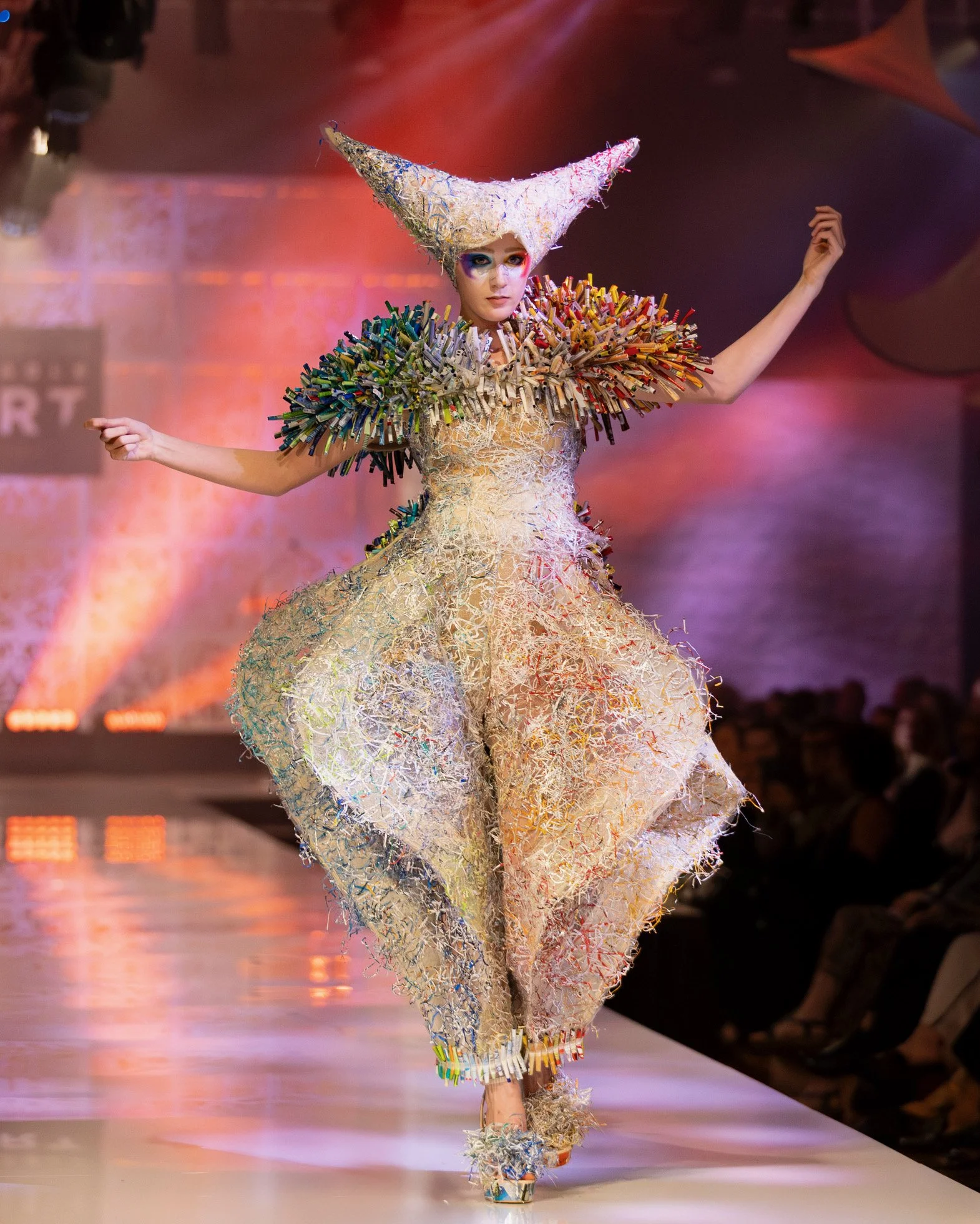
Photo Credits:
First + Second Photo: Model Lilah Young and photographed by Barry Alsop